WASHINGTON, D.C.
SEPTEMBER 30, 2026
STRANGERS: Annie Nardolilli & Louisa Hall
LOCATION: La Betty, 420 K Street NW, Washington, D.C.
THEME: A musical comedy duo’s quest to turn viral hits into a real career
Hey girl, let’s go to the beach
The sun is out, but we will bring the heat
Let’s do our hair up, let’s get in the mood
I’m looking pretty but you don’t look so good
Because we’re not at the beach to have fun
Because the year is 1881
And I have tuberculosis
While Annie Nardolilli reads out the lyrics to a delightfully morbid song, she points to Louisa Hall across the table to let me know when she’d sing certain lines if they were on stage. I don’t want to spoil the full number, but let’s share the closing lines too:
Spreading diseases to each other, Victorian era song of the summer
It was this or leeches. This is better. Victorian era song of the summer
I got swamp ass in my bustle Victorian era song of the summer
And by the way, I have cholera. Victorian era song of the summer
Louisa laughs. “And that is a prime example of an Annie song.”
Welcome to dinner with Griefcat.
That’s the singer-songwriter pairing of Annie and Louisa, friends from the D.C. area who write catchy, viral songs about topics that may not cross Taylor Swift’s mind when penning a tune: poop at work, Diet Coke as a cigarette, the Virginia state flag, the relief of taking your bra off.
That last one, “I Already Took Off My Bra,” has racked up 50 million views across social media, and Viola Davis shared it on her Instagram. The duo has been on The Kelly Clarkson Show to talk about their music. As is typical, they wear matching outfits – a trend that’s led one fan and her mom to take bets on what they’ll have on at their next appearance.
Full disclosure: Louisa is not a stranger to me. I interviewed her in May 2014, when she was a solo ukulele-playing songwriter. She penned quirky earworms like her ode to a coffee shop crush “Barista Boyfriend.” “My life dream is to be the lady Flight of the Conchords,” she said.
Well, there’s two people in Flight of the Conchords, so teaming up with Annie to form Griefcat in 2019 was a solid start. But before we get to that, a spotlight on the legit stranger Annie.
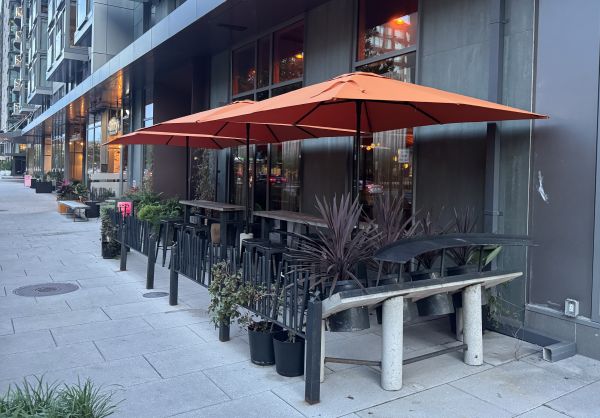
The three of us are at La Betty, a wood-beamed restaurant downtown. Glass globe lights hang at different heights on thin black cords, a shaggy red patterned rug covers part of the floor, and a deep blue sofa sits among the armchairs, like a living room got a liquor license.
Annie, sitting to my side, tells me that she was born in D.C. and grew up in Arlington, Virginia, where she lives with her husband. She went to college in Philadelphia, playing in a marching band and the occasional solo gig (she’s a guitarist).
After college she couldn’t find a job in Philadelphia, so she started looking back home and found the Arlington County website advertising openings at the sheriff’s office. She had no idea what a sheriff’s office did. “I kind of thought it was just like people wearing funny hats, like ceremonial, I guess.” Then she interviewed and learned the job involved a police academy and working in a jail. She was desperate for work. “That didn’t scare me off.”
“It was kind of crazy” that she worked in the jail before attending the academy. Then came six months at the academy and several more months of training, and then she was on her own. “Just me and 70 of my closest incarcerated friends in a room together at age 22.”
How does a 22-year-old command a room like that? Annie thinks it overlaps with performing, with “trying to get people on your side.”
Her version: “I was genuinely kind to people and wasn’t a dick.” She figures the residents appreciated it compared with deputies who ruled with an iron fist. The rules still applied and she applied them, but everyone was stuck in the jail together for 12 hours. “My philosophy was, I’m not trying to make my day any harder, so I’m not going to make your day harder.”
She spent four years at the Arlington County Sheriff’s Office and one at Loudoun County’s. By then it was 2020. “I don’t know if you remember back then, but law enforcement in 2020, not a really great time,” she says dryly. She tried the “be the change you wish to see in the world” approach, but “you’ve got to know when to fold them and get out of there.”
These days she pet sits. “It’s a very flexible schedule. Working with animals, not people.”
Annie’s work with her guitar goes back to fifth grade and a single influence: Michelle Branch, whom Annie calls “the prototype to Taylor Swift,” a girl with a guitar singing songs in the early 2000s alongside Vanessa Carlton and Avril Lavigne. Annie latched on to Branch and took up the instrument.
A middle school talent show followed (“I guess I just wanted validation”), and she was writing songs almost immediately. The first was an earnest seventh grade ode to her eighth grade boyfriend. “They weren’t very good or funny,” she says deadpan.
Still, she persisted. Odd ideas for songs came up, like an ode to a park ranger – maybe that kind of wry music could get her places like “Saturday Night Live”? She shakes her head. “In hindsight, I’m like, no, they weren’t that good, but you’ve got to start somewhere.”
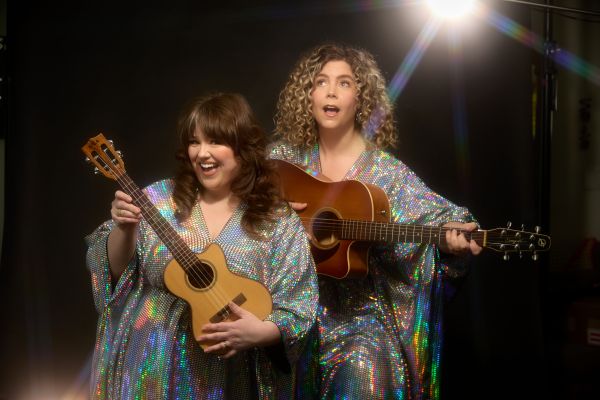
She and Louisa met in 2015 at a comedy showcase and chatted backstage. Had they seen each other’s work before? In perfect, unprompted sync they say: “No, that was the first time.”
Louisa adds, “It was the first time I’d met like another singer-songwriter who also did like the kind of sweetly silly songs but not like ha-ha funny. I think becoming a band together really kind of brought that out a lot more in our writing and performing, and then we started kind of becoming more of a comedy act versus just a musical act.”
But they were fast fans of what the other was doing. Still, for about four years, nothing happened. They kept running into each other at shows. Then one time at the 9:30 Club in D.C., Annie played a song called “Loving You Is Like Getting Chipotle,” and Louisa decided it was the funniest thing she’d ever heard. They joked about forming a band.
Louisa mentioned her cat and a phrase she came up with: Griefcat. As their website defines it: “From the German word ‘kummerspeck’ or in English ‘grief bacon,’ the weight you gain from emotional eating or, in this case, the cat you get after a breakup.”
“That’s our band name,” Annie told her.
Griefcat’s first rehearsals, Louisa says, were “lightning in a bottle.” The songs were really funny, the harmonies were tight, and they were having a really good time.
That was 2019. They’re now seven years in.
Louisa says Annie is the driver behind much of Griefcat’s creative output and social media success. Annie’s version is simpler: “I post stuff that I think other people would want to see.”
The first video to go viral was a live clip of “Revolution (Poop at Work),” from their album Late Stage Capitalism, posted to promote their first World Toilet Day show. Every year they put together an event, including performing, to raise funds for the Crohn’s and Colitis Foundation. Their pooping at work video hit a million views and “just kind of skyrocketed from there,” Louisa says. More viral videos followed, the biggest being the bra song.
So a happy ending, right? Online fame and fortune.
Not quite. “Virality is not necessarily substantive,” Annie says. “We’re not making money from the views.” A viral video is a great dopamine hit and social media still matters, she adds, but they’re working on translating online success into the in-person kind.
What does that look like? “Butts in seats,” Louisa says.
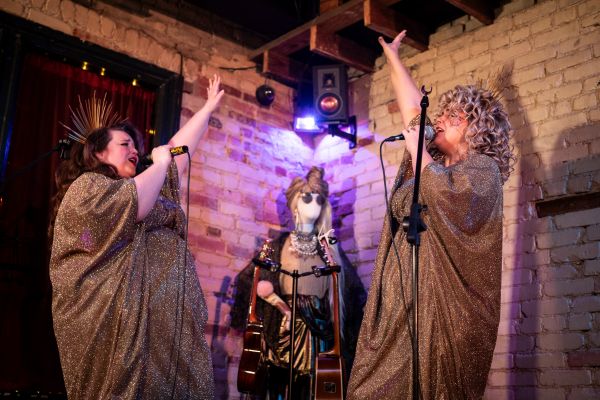
Annie fills in the detail: announcing a show in a town and having people come “and we don’t have to grovel on our knees for people to trust us that we actually have a good live show.”
I’m bamboozled by the fact that millions of online views don’t turn into ticket sales. She points to acts opening for a stadium tour who have fewer Instagram followers than Griefcat does, while Griefcat plays small venues and sells a modest number of tickets.
“I think people are surprised by that,” Annie says.
Louisa adds, “It translates to some butts.”
She sees the problem as one of perception. “People often see us as content creators versus a live act. There’s a lot of people out there that solely do content creation. And then they play a live show and they probably suck live in a lot of cases.”
“We are much better live, so you gotta buy a ticket,” adds Annie.
At shows, people mouth along to every word, and some cry laughing. “It’s such an honor,” Louisa says. “We’re telling a joke, but we’re bringing light to somebody’s day when they might really need it.”
If you go to a Griefcat gig, odds are you’re in for a memorable evening. It’s quite the sight: their sparkling, colorful matching outfits, Louisa’s energetic ukulele and Annie’s assured guitar. When one of them isn’t on an instrument, they’re singing with maximum animation. Between songs they’ll joke with the crowd and keep a constant high energy.
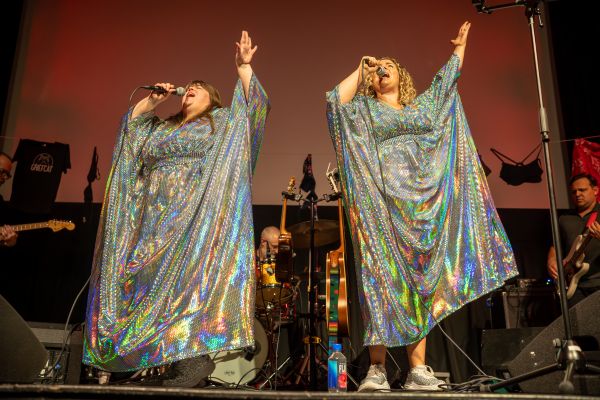
Griefcat, Louisa says, has evolved into a live musical comedy act. The evolution is ongoing, with the goal of making the band a full-time career.
Don’t get them wrong, virality helps, not hinders in that quest. That includes the Kelly Clarkson appearance. Annie says it was great for clout: when the duo is introduced at a gig as having been on that show, “oooh, that’s very fancy.”
“Our bio will never be the same,” Louisa says.
Annie repeats it back, word for word. It’s one of several times they either echo the exact words of the other or, more amusingly, say the same thing at the same time.
While the Kelly Clarkson show got them lots of eyes, Annie says “in terms of substantive dollars in the pocket, moving the needle? Not necessarily.”
What’s worked better is a 30-second song about the Virginia state flag, “Virginia is for Titties,” which went viral around the same time. Louisa says it’s the first time they’ve really been able to capitalize on a viral moment: they’ve extended it, put merch on it, and people now turn up at shows because they saw the video. It has become a key moment in the live set.
They’ve also just signed a manager who already represented acts they admire. Louisa emailed to ask for an informational interview, and although the manager wasn’t planning to add anyone to her roster, she made an exception. They’d been “making this up,” Louisa says, and the manager brings strategy. “I really do feel like she’s the third Griefcat.”
I ask Annie what separates Griefcat from the park ranger songs, but first our food arrives.
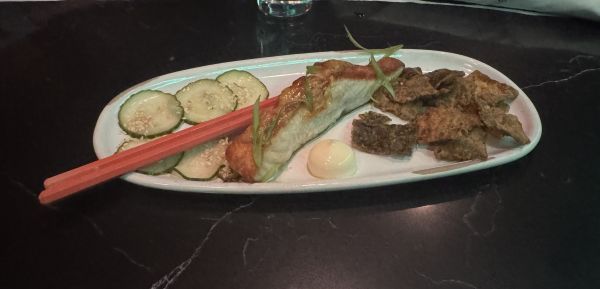
For Annie, the chili crisp salmon, with tempura crackers, sesame ginger cucumbers, Kewpie and scallions.
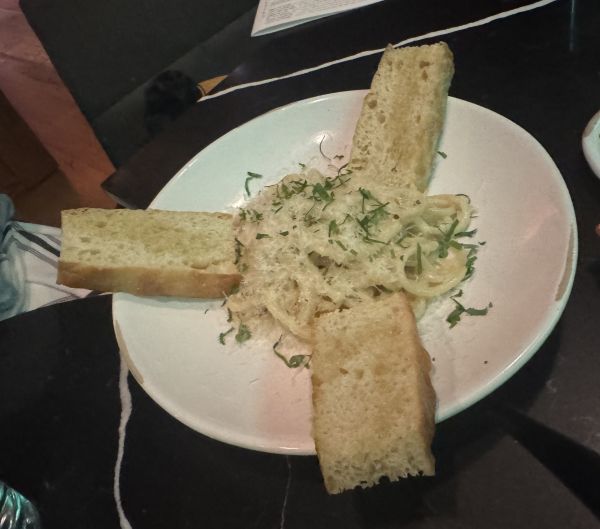
It’s Betty’s Spaghetti for Louisa: cheesy parmesan and cheddar bucatini with salted focaccia.
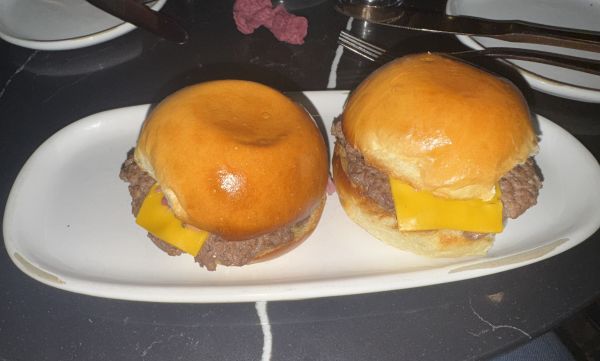
I’ve ordered the sliders: two all beef cheeseburgers with American cheese and a special slaw, on house made Parker House rolls. The rolls are ridiculously buttery, and the slaw brings a tang that keeps it from getting too rich.
With the plates down, Annie circles back to my question. “Before, I felt like the haha humor was like a tool to deflect being vulnerable,” she says. Being earnest was scary enough, so she’d pepper in jokes “to sort of like throw people off the scent of I’m actually baring my soul.” Now the humor is just about making people laugh, and it isn’t about her.
Griefcat’s songs mostly aren’t written from their own perspectives anymore; they’re funny stories or funny takes on things. “It’s a lot more like a stand-up comedian,” explains Annie.
These days they write a lot of it apart. They keep a long shared list of song ideas, mostly words and fragments. Annie’s latest update included an entry that reads, in full, “balloons.”
As a lifelong fan of the Beatles, I ask whether there’s a Lennon-McCartney difference between their writing and musical styles, so you can tell a Hall or Nardolilli tune apart.
Louisa thinks an Annie song starts with the joke, pointed and clear, while she tends to start from a melody and let the rhymes lead her. She also gets more dramatic when singing. If a song involves dragons, it’s probably hers. “I just read romance novels constantly.”
Annie says her pet sitting helps with the writing. She won’t wear headphones when walking dogs, so she thinks through songs and repeats them in her head.
They also get to flex their music and lyric writing with a side job. They write children’s songs for Art with Lauren, which Annie describes as Bob Ross for kids. The hosts, Lauren and Kevin, send a topic such as the Taj Mahal, the duo writes a song, and Lauren and Kevin turn it into a piano piece the children warm up to before painting the Taj Mahal together.
The duo also writes podcast themes, including for Two Guys on a Plane, a flight attendant podcast. One of its hosts heard “Fridge Cigarette,” Griefcat’s Diet Coke song set to the tune of “Pink Pony Club,” and asked if the band could write something for them. Another theme was for the National Association to Advance Fat Acceptance, whose CEO reached out after a show.
Louisa calls it a cool income stream, and one that uses their skills as musicians and songwriters rather than just comedians. But comedy is what they keep coming back to, including the just-released video for their latest song, “Too Cute to Go to War.”
They’re a comedy musical duo, so I ask whether they mind being called the female Flight of the Conchords. “No, I mean those are really excellent musical comedians,” says Annie.
“We get a lot of ‘Tenacious double-Ds,’” Louisa says. Boob joke!
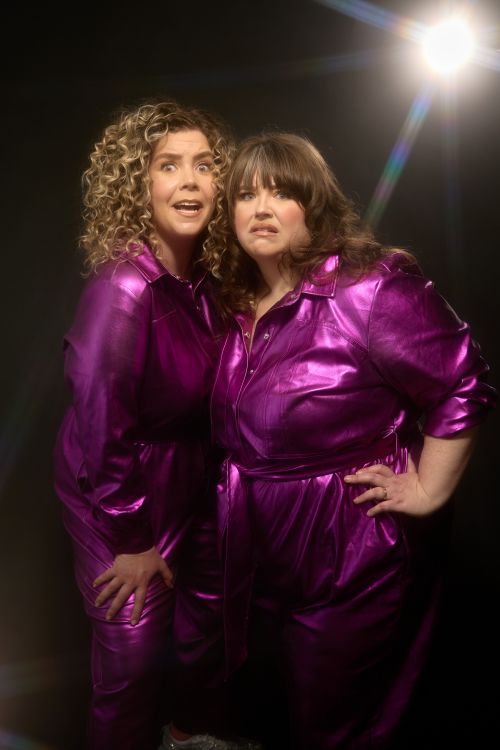
This year they entered their first comedy festival, the RISE Comedy Festival & Competition. They won the whole thing. Louisa says it’s fun to see that they belong in those spaces and thrive in them. Until now they’ve mostly played music festivals; now they’re booking comedy festivals.
One great night, both agree, was Chicago in August. A 40-person room, sold out, and an audience that Annie says was “on fire the entire time. There was never a dip.” They were, in her words, “down to clown.”
What’s the goal from here? “World domination,” Louisa says.
“Definitely world domination,” Annie agrees.
More practically, Annie wants to be a support act for someone who’s properly touring, with the tour T-shirt and maybe a bus. A lot of what they do now is “ad hoc, weekend warrior”: a random gig or festival here and there.
“We’re not there yet” on going full time, Louisa says, but they’re more successful this year than ever.
The long game helps. In music, Annie says, youth is rewarded: you’re supposed to peak at 19, 20, 21. Comedy takes about 10 years, so being seven years in means they’re still early. “Comedy feels a lot more evergreen because you can just be funny forever.”
Louisa remembers worrying that Griefcat needed to make it before she turned 40. “It certainly didn’t. But it doesn’t matter.”
I tell them that from an outsider’s perspective looking at their trajectory, they appear to be on the cusp of realizing their dream of making Griefcat full time. Then I’ll be able to say I knew them before they became famous and stopped talking to me.
“It does feel like we are on the cusp a little bit,” Louisa says. “It feels great.”
By the end of the meal, I have an inkling of how I’m going to portray the two in writing up the dinner. But I ask how they think a magazine profile would describe them.
“We’re both stunning and brilliant,” Annie says.
“And very talented musicians,” Louisa adds.
It’s said sardonically, but you know what they say about truth in humor. This is a quick-witted duo that appears fully in sync.
As the evening winds down, we get ready to leave. But first I ask the bartender to take a photo of the three of us. She looks at Annie and Louisa and says, “I know Griefcat.” She takes the picture, then talks with them for a while.
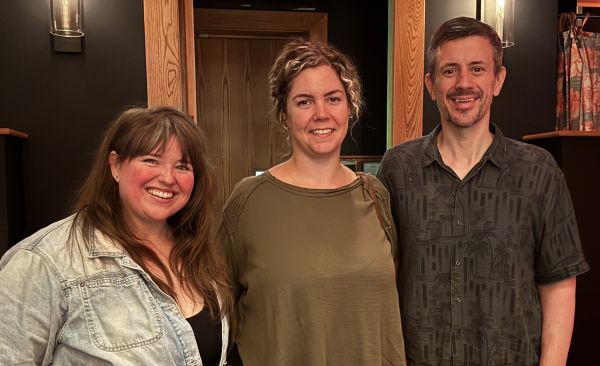
It’s one stranger at one bar, but it’s the kind of recognition that doesn’t show up in a view count. Fans could be anywhere, including behind the bar at La Betty. And who knows – maybe she’ll be one of the butts in seats at the next Griefcat gig.